Premium export product by rajendra traders
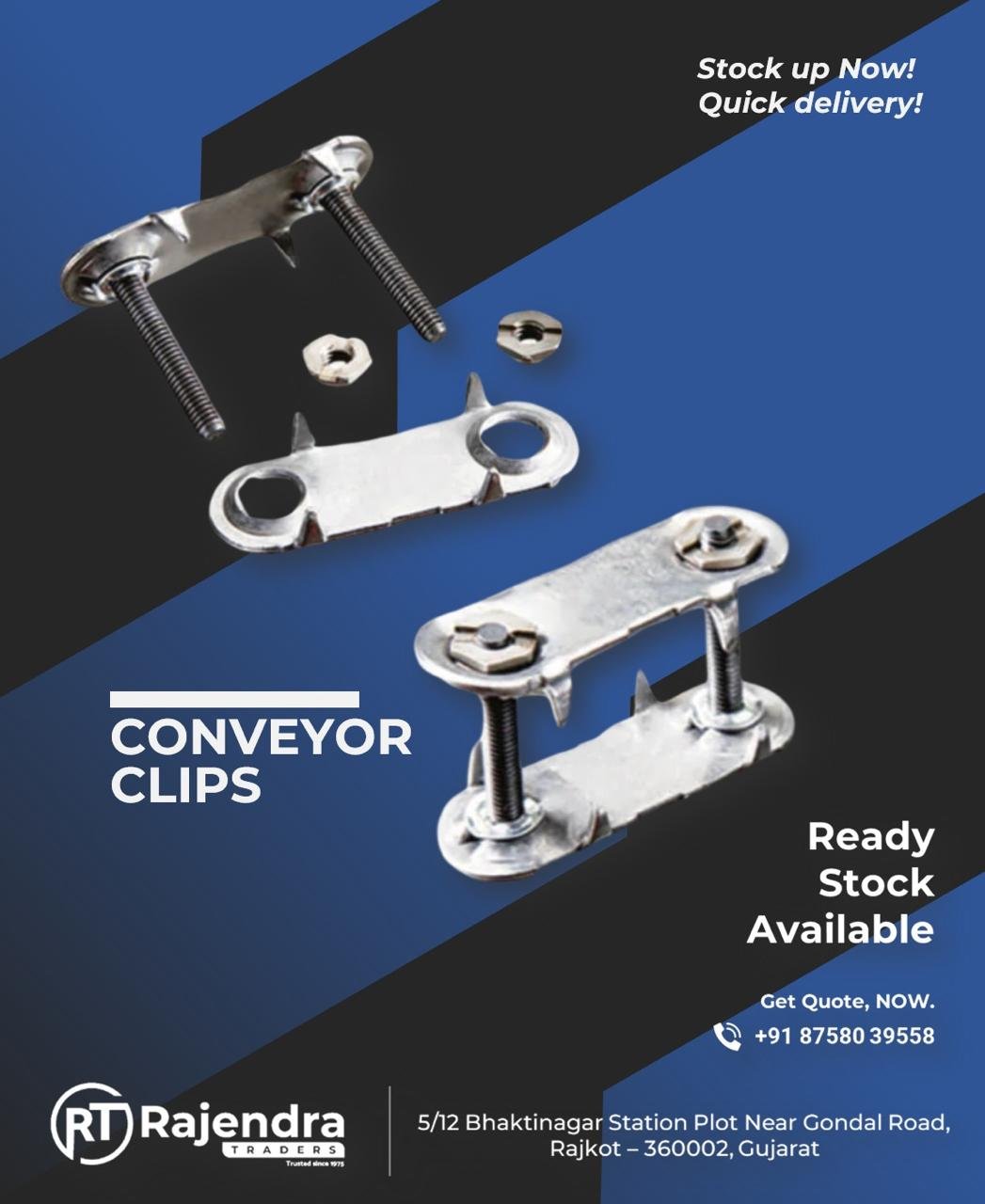
Product Specification: Conveyor Clips (Skirt Clamps)
Conveyor Clips, often referred to as Skirt Clamps or Liner Clamps, are specialized fastening systems used to secure rubber skirting or wear liners to the sides of a conveyor belt's loading zone. Their primary purpose is to create a seal that prevents material spillage and controls dust, without damaging the moving conveyor belt.
1. Primary Types of Conveyor Clips
Depending on the heavy-duty nature of the application, these clips vary in their mechanical design:
Wedge-Type Clamps: Use a hammer-driven wedge to apply downward pressure on the skirting. These are popular in mining because they don't have threads that can get clogged with dust or grit.
Toggle / Over-Center Clamps: Use a quick-release lever mechanism. These allow for very fast adjustment or replacement of the rubber skirt without tools.
Threaded Bolt Clamps: Use a traditional nut-and-bolt or hand-wheel system. These allow for precise pressure adjustment but can be slower to maintain.
2. Material & Finish
Because they are often located in "wet" or abrasive zones, material durability is key:
Component Material Options Properties
Main Body/Handle Ductile Iron or Carbon Steel High impact resistance for mining/quarrying.
Internal Hardware Stainless Steel (304/316) Prevents seizing in corrosive or wash-down environments.
Surface Finish Hot-Dip Galvanized / Zinc Standard rust protection.
Mounting Bar Mild Steel Usually welded directly to the conveyor chute side-wall.
3. Key Technical Features
Tool-Free Adjustment: Most modern conveyor clips are designed to be adjusted by hand or with a simple hammer strike, reducing downtime during "skirt-adjustments."
Interlocking Design: Many systems allow the clips to be mounted end-to-end in a continuous row to ensure no "gaps" in the skirting seal.
Vibration Resistance: High-quality clips feature locking mechanisms (like serrated wedges or locking pins) to prevent the clamp from vibrating loose during high-speed belt operation.
4. Dimensional Standards
Conveyor clips are typically sized by the thickness of the skirting they are designed to hold:
Standard Range: Accommodates skirting thickness from $6\text{mm}$ to $25\text{mm}$.
Length: Clamping plates are usually $150\text{mm}$ to $300\text{mm}$ long.
Spacing: Typically installed every $300\text{mm}$ to $500\text{mm}$ along the conveyor chute.
5. Installation Performance
Welding the Mount: The back-bar of the clip system is welded to the outside of the conveyor's chute wall.
Positioning the Skirt: The rubber skirting is placed between the chute wall and the clamp plate.
Applying Pressure: The wedge or lever is engaged. The skirting should touch the conveyor belt lightly; too much pressure will cause friction heat and wear out the belt surface.
6. Maintenance & Safety
"Nipping" the Skirt: As the bottom of the rubber skirt wears down, the clips are loosened, the rubber is dropped down a few millimeters, and the clips are retightened.
Avoid "Pinching": Clips should be adjusted so the skirting is just "kissing" the belt. If the clip allows the skirt to fold inward, it can trap rocks against the belt, causing a catastrophic "groove" or tear.
Contact our export experts for detailed specifications, pricing, and shipping information.
Contact rajendra traders