Premium export product by rajendra traders
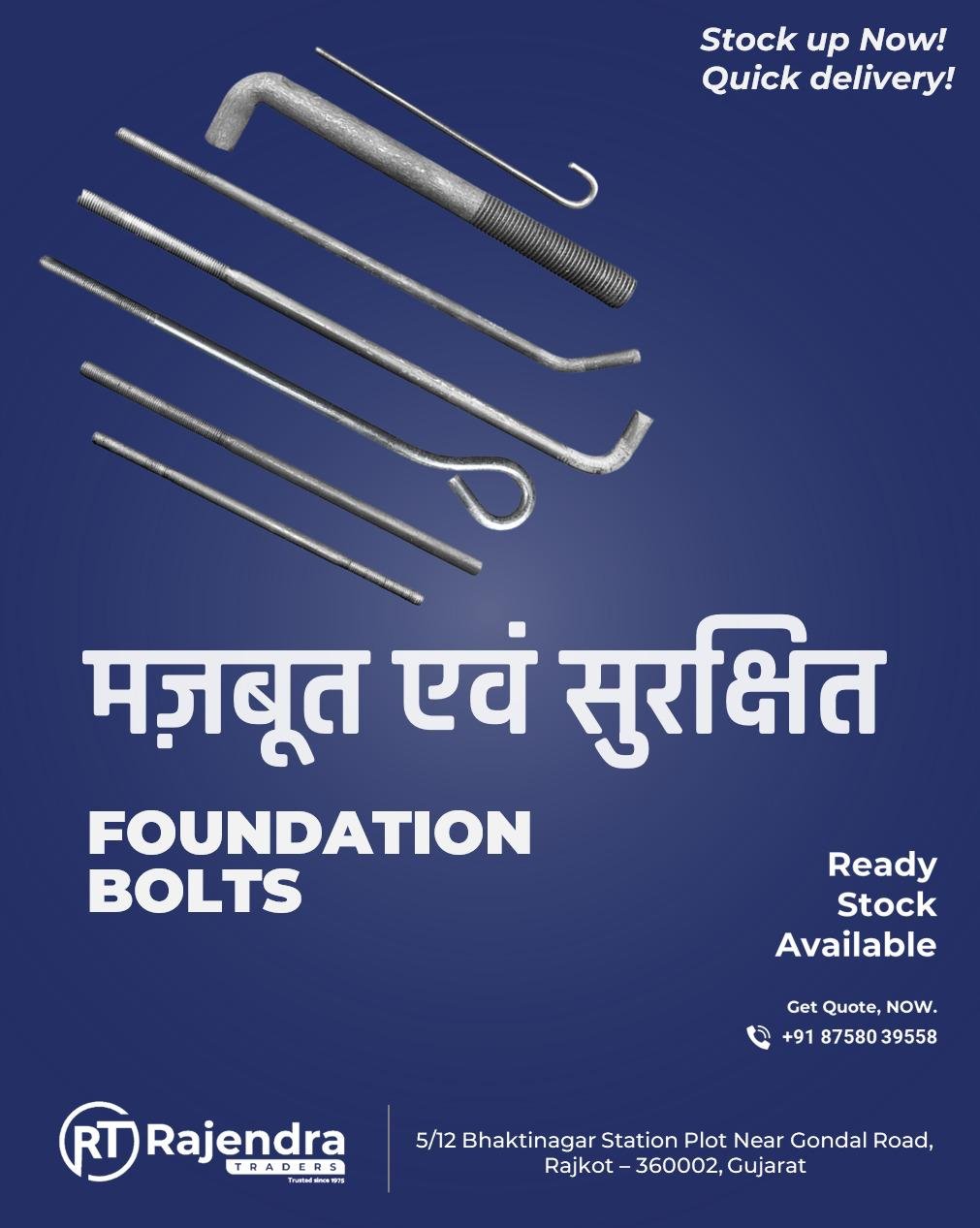
Product Specification :
Product Specification: Foundation Bolts (Anchor Bolts)
Foundation Bolts are heavy-duty fasteners used to connect structural and non-structural elements to concrete foundations. They are embedded directly into the wet concrete during the pouring process (cast-in-place) or retrofitted into cured concrete to secure steel columns, light poles, and heavy industrial machinery.
1. Primary Types & Geometry
Foundation bolts are classified by their shape, which provides the "mechanical interlock" required to prevent the bolt from pulling out of the concrete.
L-Type (J-Bolt): The most common variety, featuring a $90^\circ$ bend at the bottom. The hook provides anchorage.
Bent V-Type: Similar to the L-type but with a sharper V-bend for specific load requirements.
Plate Bolts (T-Type): A straight threaded rod with a square or circular steel plate welded or nutted to the bottom. These offer the highest pull-out resistance.
Double-End Studs: Threaded on both ends; used with a template to ensure precise alignment before the concrete sets.
2. Material & Grades
Foundation bolts must withstand significant tensile and shear forces. They are typically manufactured according to ASTM F1554 standards:
Grade Yield Strength Application
Grade 36 $36\text{ ksi}$ Low-carbon steel; general-purpose construction.
Grade 55 $55\text{ ksi}$ High-strength, low-alloy steel; standard for most structural steel.
Grade 105 $105\text{ ksi}$ Alloy steel, heat-treated; used for heavy industrial or high-vibration machinery.
3. Technical Specifications
Diameters: Standard sizes range from 1/2" ($M12$) for residential sills to 3" ($M76$)+ for industrial bridge abutments.
Length: Can range from 6 inches to several feet, depending on the required "embedment depth."
Thread Length: Usually $3" \text{ to } 6"$ at the top to allow for leveling nuts, base plates, and washers.
Finish:
Plain/Black: For interior use or temporary structures.
Hot-Dip Galvanized (HDG): Required for any bolt exposed to weather or moisture.
4. Installation & Performance
The strength of a foundation bolt is not just in the steel, but in the Embedment Depth.
Placement: Bolts are often held in place by a wooden or metal template to ensure they remain perfectly vertical and at the correct "center-to-center" distance during the concrete pour.
Projection: The "thread projection" must be calculated to account for the thickness of the grout bed, the base plate, the washer, and the nut.
Consolidation: The concrete around the bolt must be vibrated to ensure there are no air pockets (voids) around the hook or plate, which would weaken the anchor.
5. Critical Failures to Avoid
Edge Distance: If a bolt is placed too close to the edge of the concrete pier, the lateral force can cause the concrete to "spall" or break away.
Nut Leveling: Often, a "leveling nut" is placed under the base plate, and the gap is later filled with non-shrink grout.
Galvanic Corrosion: If using a stainless steel base plate, ensure the foundation bolts are also stainless or properly insulated to prevent chemical reaction.
Contact our export experts for detailed specifications, pricing, and shipping information.
Contact rajendra traders