Premium export product by rajendra traders
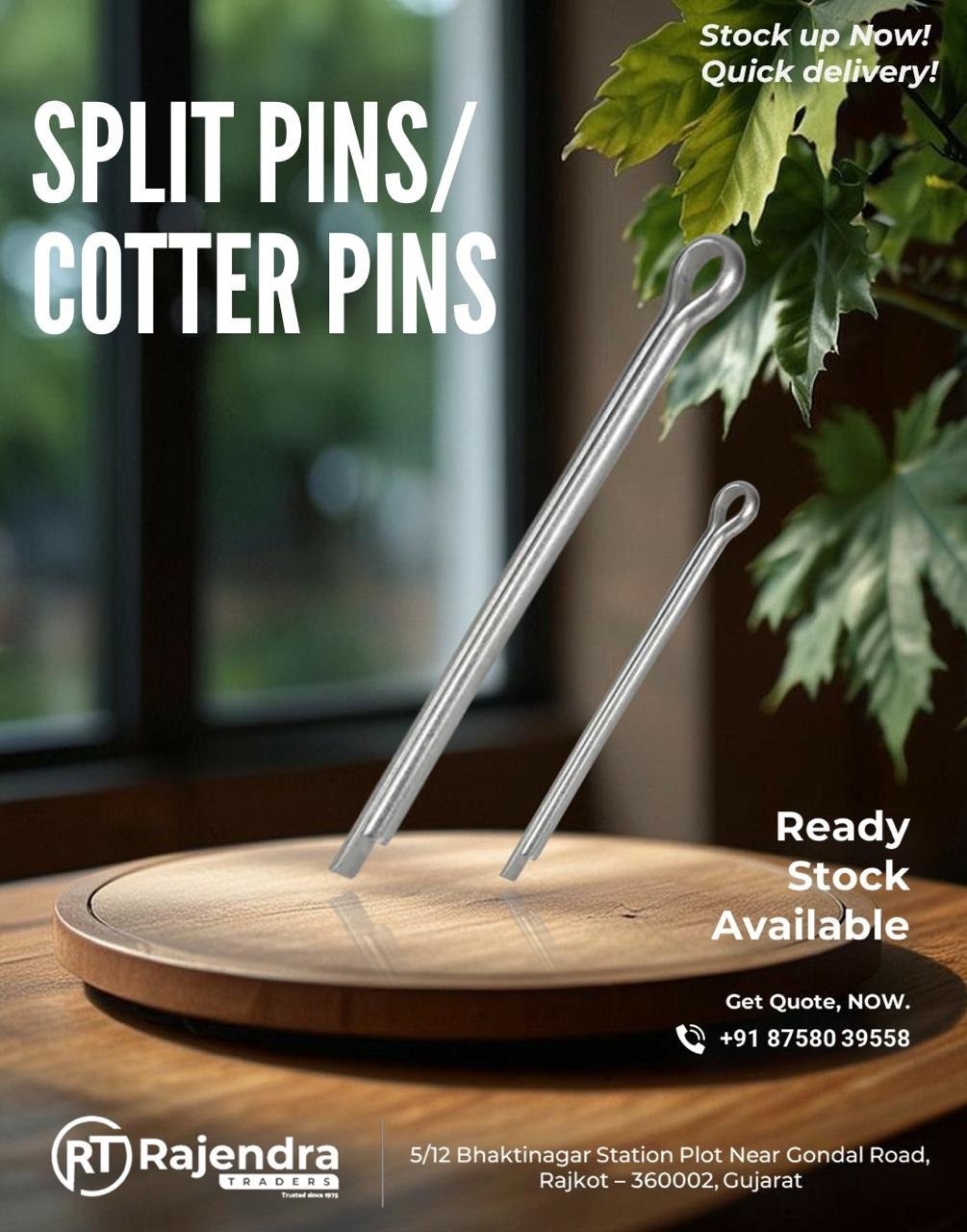
Product Specification :
A Cotter Pin, also known as a split pin, is a simple metal fastener with two tines that are bent during installation. It is used to secure bolts, pins, or shafts in place, typically acting as a safety locking device to prevent a nut from backing off a threaded fastener (especially when used with a castle nut or slotted nut).
+1
1. General Characteristics
Design: A half-round wire folded in half to form a loop (eye) at one end.
Function: Inserted into a pre-drilled hole; the two protruding ends (tines) are then spread apart to lock the pin in position.
Point Styles:
Chisel Point: Standard angled ends for easy spreading.
Extended Prong: One tine is longer than the other to make it easier to separate them with pliers.
Hammer Lock: Designed so that a strike from a hammer automatically spreads the prongs.
2. Material & Construction
3. Dimensional Standards
Cotter pins are sized by their nominal diameter and length.
Standards: ISO 1234, DIN 94, or ASME B18.8.1.
Measurement: The length is measured from under the eye (the short side) to the end of the shortest tine.
Common Metric Sizes:
Diameters: 1.0mm, 1.6mm, 2.0mm, 3.2mm, 4.0mm, 5.0mm, 6.3mm, 8.0mm.
Lengths: 10mm to 100mm+.
4. Key Performance Requirements
Ductility: The material must be soft enough to bend 90° to 180° without cracking, but stiff enough to resist vibration.
Corrosion Resistance: Stainless steel (A4) is required for marine or automotive underbody applications to prevent the pin from rusting and seizing inside the hole.
Shear Strength: While not designed to take primary loads, they must resist the shearing force of a nut attempting to rotate.
5. Common Applications
Automotive: Securing tie-rod ends, ball joints, and wheel bearing nuts (axle nuts).
Industrial: Locking clevis pins in linkage systems.
Bicycles: Retaining brake pads in certain disc brake calipers.
6. Installation & Safety Tips
One-Time Use: Never reuse a cotter pin. Once the tines have been bent and straightened, the metal experiences "work hardening" and becomes brittle. A reused pin is prone to snapping under vibration.
Proper Sizing: The pin should fill at least 75% of the hole diameter to prevent excessive "slop" or movement.
Bending Technique: Usually, one prong is bent back over the nut and the other is bent down against the side of the nut.
Contact our export experts for detailed specifications, pricing, and shipping information.
Contact rajendra traders