Premium export product by rajendra traders
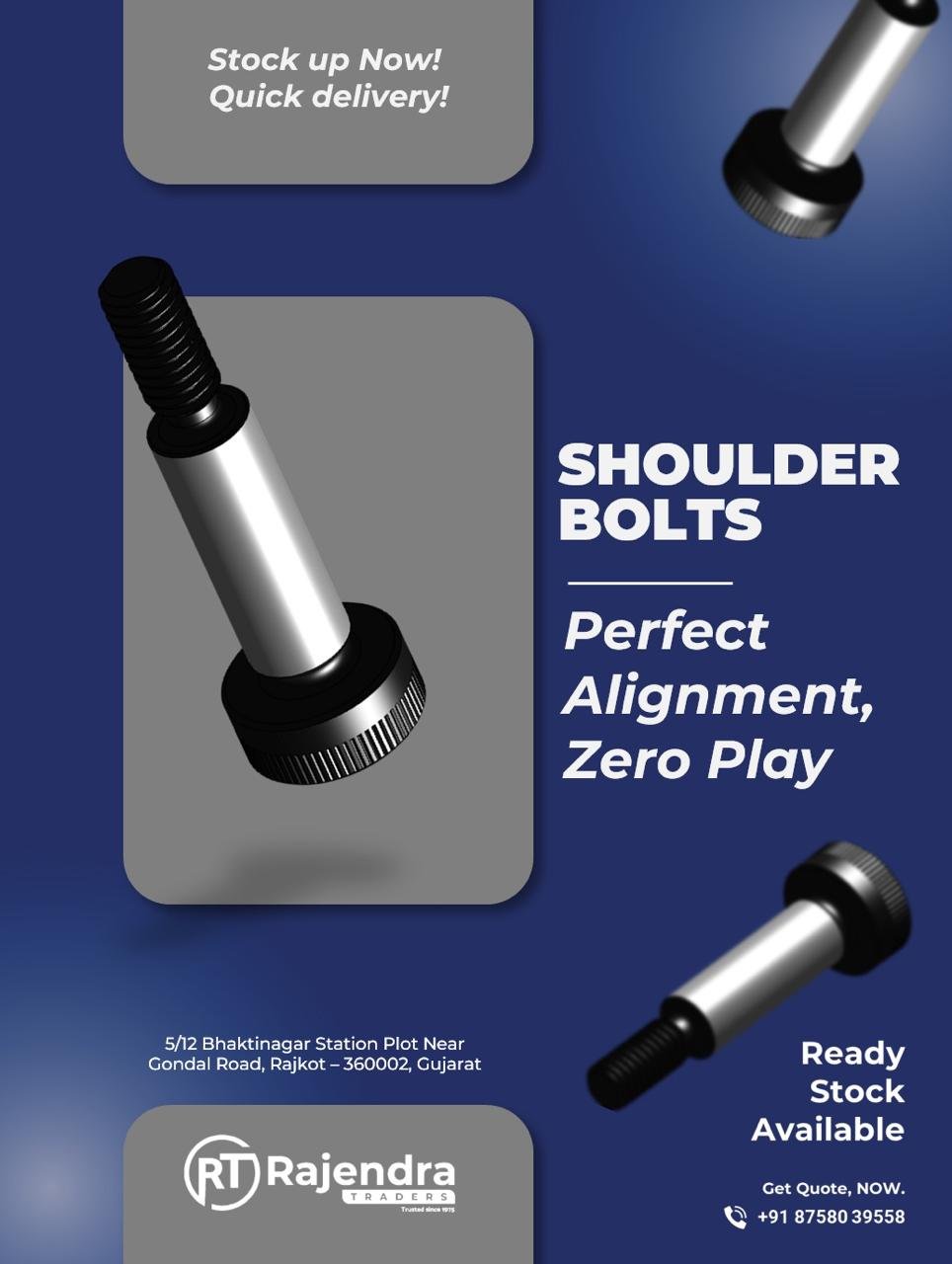
Product Specification :
Product Specification: Shoulder Bolts (Stripper Bolts)
Shoulder Bolts, also commonly known as Stripper Bolts, are unique fasteners with three distinct sections: a head, an unthreaded enlarged shoulder, and a smaller diameter threaded end. They act as shafts, dowels, or pivots for moving parts, allowing for rotation or sliding while the threaded end is secured into a base component.
+1
1. Anatomy and Design
The precision of a shoulder bolt lies in the relationship between its three parts:
The Head: Usually a socket head (driven by an Allen key) to allow for high torque in recessed areas.
The Shoulder: A precision-ground smooth cylinder. The length and diameter of the shoulder are the most critical dimensions.
The Threaded Neck: A smaller diameter section that secures the bolt into the assembly.
2. Technical Specifications & Tolerances
Shoulder bolts are "precision" fasteners, meaning they are manufactured to much tighter tolerances than standard hex bolts.
Feature Metric Specification Imperial Specification
Diameter Tolerance h8 (e.g., $+0.000 / -0.033\text{mm}$) $+0.000 / -0.002\text{ inches}$
Material Alloy Steel or 303/316 Stainless Alloy Steel or 303/316 Stainless
Hardness (Alloy) $32\text{--}43 \text{ HRC}$ $32\text{--}43 \text{ HRC}$
Tensile Strength Up to $1100\text{ MPa}$ Up to $140,000\text{ PSI}$
3. Key Dimensions for Selection
When ordering shoulder bolts, you must specify four dimensions:
Shoulder Diameter: The diameter of the smooth shaft (determines the size of the hole in the moving part).
Shoulder Length: The length of the smooth shaft (determines the "travel" or thickness of the parts being held).
Thread Diameter: Often one size smaller than the shoulder (e.g., a $10\text{mm}$ shoulder bolt usually has an $M8$ thread).
Thread Length: The length of the threaded portion.
4. Common Applications
Pivot Points: Acting as an axle for pulleys, gears, or rollers.
Linkages: Connecting moving arms in mechanical assemblies.
Punch and Die Sets: In tool and die making, they are used as "stripper bolts" to guide the stripping plate as it moves against spring pressure.
Guides: Used as sliding rails for drawer mechanisms or heavy machinery slides.
5. Installation Performance
Seating: The shoulder should be tightened until the "undercut" (the shoulder face) sits flush against the base material. The moving part then sits on the shoulder with a slight clearance.
Pre-loading: Because the shoulder is meant to bottom out against a surface, you can apply high torque to the threads without "squeezing" or binding the moving part.
Reaming: To ensure a smooth fit, the hole in the moving part is often reamed rather than just drilled, ensuring it matches the "h8" tolerance of the shoulder bolt.
Contact our export experts for detailed specifications, pricing, and shipping information.
Contact rajendra traders