Premium export product by rajendra traders
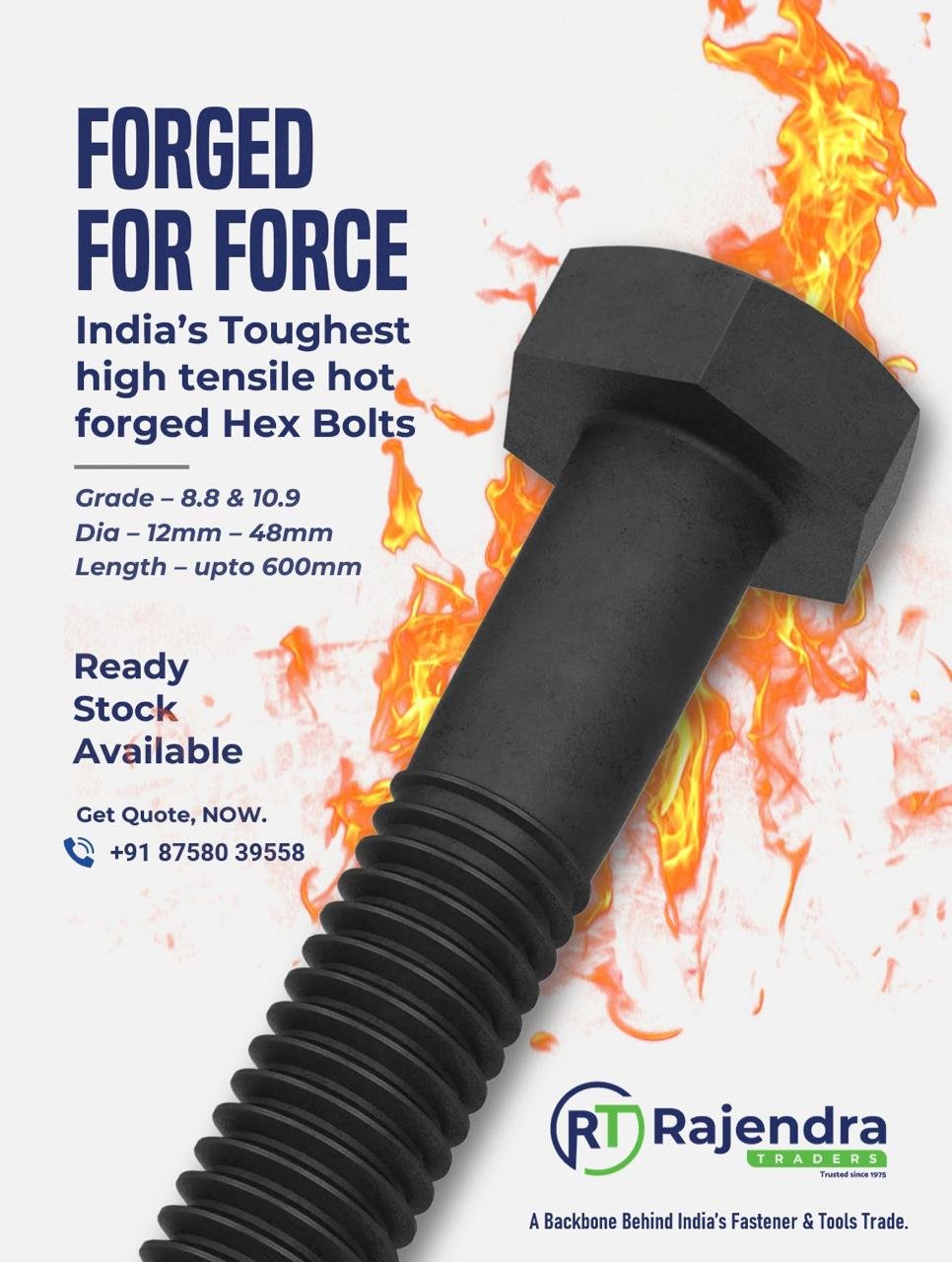
Product Specification :
Product Specification: High Tensile Hex Bolts
High Tensile Hex Bolts are heavy-duty fasteners designed to withstand high levels of stress and tension. Unlike standard mild steel bolts, high tensile fasteners undergo heat treatment (quenching and tempering) to achieve specific mechanical properties, making them essential for structural steelwork, automotive engines, and heavy machinery.
+1
1. Grade Identification
High tensile bolts are identified by property class markings on the head. The most common metric grades are 8.8, 10.9, and 12.9.
Grade Tensile Strength (Approx.) Yield Strength (Approx.) Typical Application
8.8 $800\text{ N/mm}^2$ $640\text{ N/mm}^2$ General structural steel, engine mounts.
10.9 $1000\text{ N/mm}^2$ $900\text{ N/mm}^2$ High-stress automotive parts (suspension).
12.9 $1200\text{ N/mm}^2$ $1080\text{ N/mm}^2$ Heavy machinery, high-pressure cylinder heads.
2. Anatomy and Dimensions
Hex Head: Designed to be driven by a standard wrench or socket.
Shank: Can be Fully Threaded (Set Screws) or Partially Threaded (Bolts).
Note: Partially threaded bolts are preferred for high-shear applications because the unthreaded "grip length" is stronger than the threaded section.
Standards: * Metric: DIN 931 (Partial Thread), DIN 933 (Full Thread), ISO 4014/4017.
Imperial: ASTM A325, SAE J429 Grade 5 or 8.
3. Material & Finish
High tensile bolts are typically forged from Medium Carbon Steel or Alloy Steel.
Black Oxide (Self-Colour): The standard finish. It provides a light oil coating but offers no real rust protection.
Zinc Plated (BZP): Good for indoor use; provides moderate corrosion resistance.
Hot-Dip Galvanized (HDG): Thick zinc coating for outdoor use.
Warning: HDG can cause "hydrogen embrittlement" in Grade 10.9 or 12.9 bolts; specialized baking processes are required during plating.
4. Technical Specifications
Proof Load: The maximum force the bolt can withstand without permanent deformation.
Hardness: Measured on the Rockwell C (HRC) or Brinell (HB) scale.
Elongation: The ability of the bolt to stretch slightly before snapping, providing a safety margin.
5. Installation Performance
High tensile bolts are designed to be "pre-loaded." When tightened to the correct torque, the bolt stretches slightly like a spring, creating a clamping force that holds the joint together by friction.
Torque Control: High tensile bolts should ideally be tightened using a calibrated torque wrench.
Washers: Always use hardened washers with high tensile bolts. A standard soft washer will "collapse" or deform under the high pressure of an 8.8+ bolt.
6. Critical Safety Considerations
Hydrogen Embrittlement: High-strength bolts (10.9 and 12.9) are susceptible to sudden, brittle failure if exposed to certain acids or plating processes without proper stress-relieving.
Never Weld: You should never weld a high tensile bolt. The heat from welding destroys the heat-treatment properties, effectively "annealing" the bolt and turning it back into weak, mild steel.
Contact our export experts for detailed specifications, pricing, and shipping information.
Contact rajendra traders