Premium export product by rajendra traders
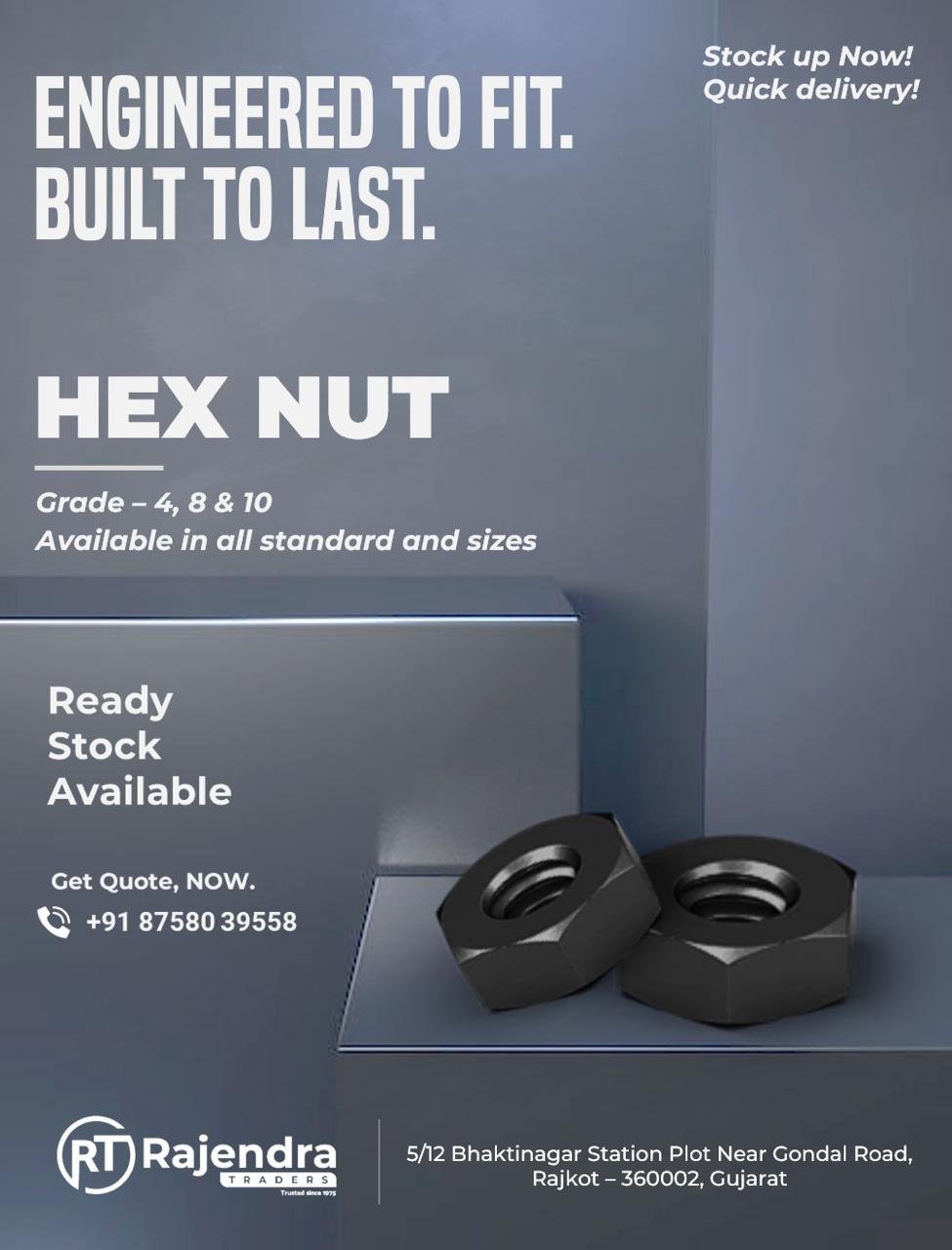
Product Specification :
Product Specification: Hexagonal Nuts (Hex Nuts)
Hex Nuts are six-sided, internally threaded fasteners used in conjunction with bolts, screws, and studs to create a secure mechanical joint. They are the most common type of nut in the world, designed to be tightened or loosened using a standard wrench (spanner) or socket.
1. Primary Types of Hex Nuts
While they all share a six-sided profile, their specific designs vary based on the application:
Type Design Feature Common Use
Standard Hex Nut Standard thickness ($0.8d$ to $1.0d$). General assembly and structural joints.
Nyloc (Nylon Insert) Features a nylon collar to prevent loosening. High-vibration areas (automotive, machinery).
Heavy Hex Nut Larger and thicker than a standard nut. High-pressure piping and structural bolting.
Jam Nut (Thin Nut) Roughly half the thickness of a standard nut. Used as a "lock nut" by jamming it against another nut.
Flange Nut Features a wide, built-in circular washer base. Distributing load on sheet metal; eliminates separate washers.
2. Material & Strength Grades
To ensure a joint holds, the nut should typically match or exceed the strength grade of the bolt it is paired with.
Metric Grades: * Grade 4 or 5: Paired with Grade 4.6 bolts (Mild Steel).
Grade 8: Paired with Grade 8.8 high tensile bolts.
Grade 10: Paired with Grade 10.9 bolts.
Imperial Grades (SAE):
Grade 2: Low carbon steel.
Grade 5: Medium carbon steel (3 radial lines on the head).
Grade 8: Alloy steel (6 radial lines on the head).
Stainless Steel: Generally marked as A2-70 (304 grade) or A4-80 (316 marine grade).
3. Key Technical Specifications
Thread Pitch: Must match the bolt exactly (Coarse/UNC vs. Fine/UNF).
Thread Direction: Standard nuts are Right-Handed. Left-hand nuts (used on rotating equipment like bicycle pedals) are usually marked with an arrow or a notch on the corners.
Across Flats (AF): The measurement between two parallel sides of the hexagon. This determines the size of the wrench required.
Proof Load: The amount of axial tension the nut can withstand without the internal threads stripping.
4. Finish & Corrosion Protection
Finish Environment
Zinc Plated Dry, indoor conditions.
Hot-Dip Galvanized Outdoor construction; requires "over-tapped" nuts to fit the thick coating.
Black Oxide Oily, industrial environments where aesthetics or light oiling is preferred.
Teflon/PTFE Chemical plants and offshore rigs to prevent "seizing" (galling).
5. Installation Performance
The "Two Thread" Rule: For a secure joint, the bolt should protrude through the nut by at least two full threads. This ensures full engagement of the nut’s load-bearing capacity.
Galling Warning: When using Stainless Steel nuts and bolts, the friction of tightening can cause the threads to "weld" together (seize).
Tip: Always use an anti-seize lubricant or choose a different grade for the nut (e.g., 304 bolt with a 316 nut).
6. Common Standards
Metric: DIN 934 (Standard), ISO 4032, DIN 985 (Nyloc).
Imperial: ASME B18.2.2.
Contact our export experts for detailed specifications, pricing, and shipping information.
Contact rajendra traders