Premium export product by rajendra traders
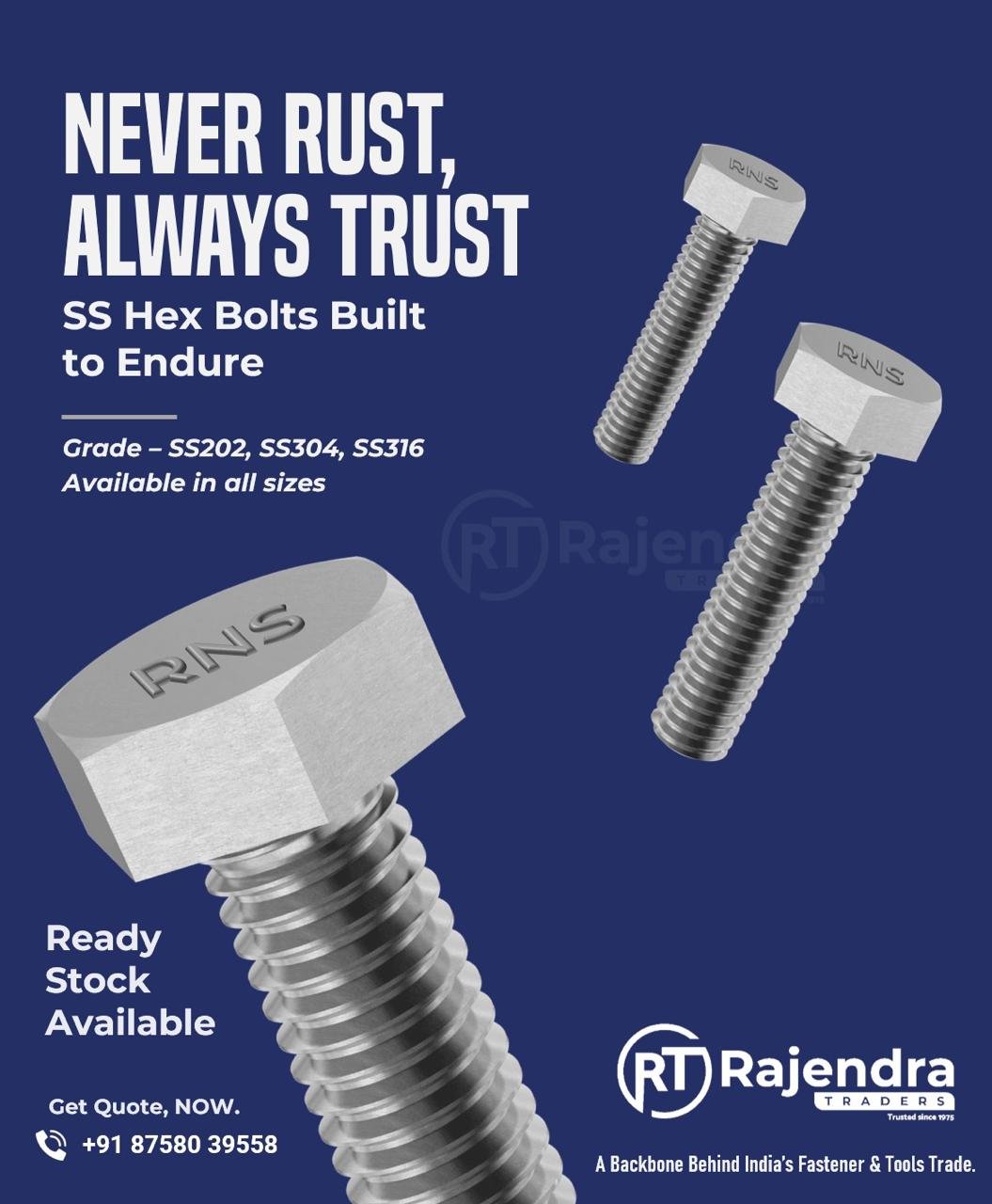
Product Specification :
Stainless Steel Hex Bolts are corrosion-resistant fasteners characterized by a hexagonal head and a threaded shank. Unlike carbon steel bolts which rely on surface coatings (like zinc) for protection, stainless steel is an alloy where the corrosion resistance is inherent throughout the material. This makes them the industry standard for marine, chemical, and food-processing environments.
+1
1. Material Grades (The "A" Series)
Stainless steel fasteners are primarily categorized by their metallurgical composition. The most common metric designations are A2 and A4.
Grade Common Name Composition Best Use
A2 (304) "18-8" Stainless 18% Chromium, 8% Nickel General outdoor use, kitchen equipment, automotive trim.
A4 (316) "Marine Grade" 18% Cr, 10% Ni, 2% Molybdenum Coastal environments, chemical plants, saltwater applications.
A4-80 High Strength Same as A4 but cold-worked Heavy-duty marine rigging or structural stainless joints.
2. Strength Classes
The number following the grade (e.g., A2-70) indicates the tensile strength.
Class 50: Soft (annealed).
Class 70: The standard strength for stainless bolts (cold-worked). It is roughly comparable to a Grade 5 (Imperial) or Class 8.8 (Metric) carbon steel bolt in terms of tensile strength, but with lower yield strength.
Class 80: High-strength stainless, achieved through intensive cold-working.
3. Anatomy & Manufacturing Standards
Head Style: Hexagonal, designed for wrench or socket driving.
Thread Type: Metric (ISO) or Imperial (UNC/UNF).
Shank Design: * DIN 933 (ISO 4017): Fully threaded (Set Screw).
DIN 931 (ISO 4014): Partially threaded with a plain shank.
4. Key Technical Specifications
Property Specification
Corrosion Resistance High (Oxidization resistant due to the Chromium-oxide "passive layer").
Magnetic Properties Generally non-magnetic (Austenitic), though cold-working can introduce slight magnetism.
Temperature Range Excellent; retains strength at high temperatures and prevents brittleness in sub-zero conditions.
Surface Finish Bright, polished, or passivated (acid-treated to enhance the protective oxide layer).
5. Installation Performance: The "Galling" Warning
The most critical technical challenge with stainless steel bolts is Galling (cold welding). During tightening, friction can cause the threads to seize together permanently.
Prevention: Always use a high-quality Anti-Seize Lubricant (nickel or copper based).
Technique: Tighten at a slow, consistent RPM. Avoid using high-speed impact drivers, which generate the heat that triggers galling.
Material Mixing: Using an A4 nut on an A2 bolt (or vice-versa) can sometimes reduce the risk of galling due to the slight difference in material hardness.
6. Primary Applications
Marine: Boat deck hardware, dock construction, and underwater fittings.
Food & Medical: Hospital equipment and commercial kitchens (due to hygiene and easy cleaning).
Solar & Energy: Mounting hardware for solar panels and wind turbines exposed to the elements.
Water Treatment: Piping and valves in desalination and sewage plants.
Contact our export experts for detailed specifications, pricing, and shipping information.
Contact rajendra traders