Premium export product by rajendra traders
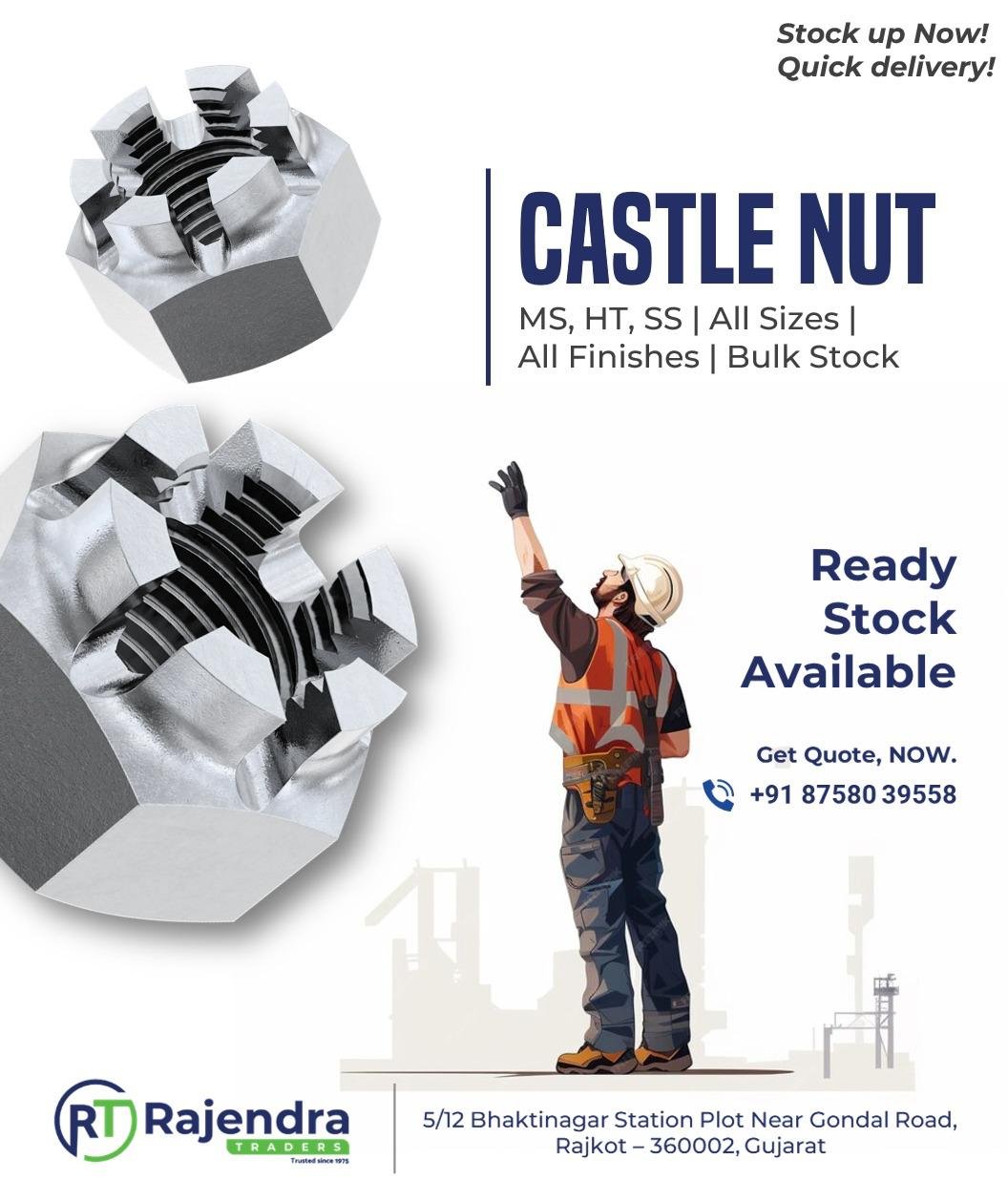
Product Specification :
A Castle Nut, also known as a Castellated Nut, is a specialized hex nut with slots (notches) cut into one end. It is designed to be used in conjunction with a bolt or stud that has a pre-drilled hole through its shank. By inserting a cotter pin or safety wire through the slots and the hole, the nut is mechanically locked in place, preventing it from backing off due to vibration or rotation.
+2
1. Anatomy and Design
The defining feature of the castle nut is the "crown" or "castle" (the slotted section) that sits atop the standard hexagonal body.
Hexagonal Base: Provides the flat surfaces for a wrench to apply torque.
Castellations (Slots): Usually 6 slots, though larger nuts may have more. These provide the channels for the locking pin.
+1
The Pilot (Neck): In true Castle Nuts (DIN 935), the slotted section is slightly smaller in diameter than the hex base. In Slotted Nuts (DIN 937), the slots are cut directly into the hex body.
2. Material & Strength Grades
Because they are frequently used in safety-critical automotive and aerospace applications, they are manufactured to strict strength standards:
Grade/Material Typical Finish Common Application
Grade 8.8 / 10.9 Zinc Plated / Yellow Zinc Automotive axles, ball joints, and tie-rod ends.
Stainless Steel (304/316) Passivated Marine steering linkages and food-grade machinery.
Alloy Steel Cadmium Plated (Aerospace) Aircraft landing gear and flight control surfaces.
3. Key Technical Specifications
Thread Pitch: Available in Metric (Coarse/Fine) and Imperial (UNC/UNF). Fine threads are preferred in high-vibration environments for better adjustment.
+1
Slot Width: Sized to accommodate standard cotter pin diameters.
Height: Total height includes the hexagonal base plus the height of the castellations.
4. Installation & Locking Procedure
The security of a castle nut relies on the correct alignment of the slots with the hole in the bolt.
Torque: Tighten the nut to the specified torque value.
Alignment: If the slots do not align with the hole in the bolt, always tighten the nut further until the next slot aligns. Never loosen a castle nut to meet the hole, as this reduces the pre-load tension.
Pinning: Insert a Cotter Pin (Split Pin) through the slot and the bolt hole.
Securing: Bend the ends of the cotter pin around the nut or over the top of the bolt to lock it permanently.
5. Common Applications
Automotive: Securing wheel bearings (spindle nuts), ball joints, and steering linkages.
Aerospace: Used on almost all pivot points and structural bolts where a fastener failure could be catastrophic.
Industrial: Heavy vibrating machinery where nylon-insert (Nyloc) nuts might melt or fail due to heat or chemical exposure.
6. Castle Nut vs. Slotted Nut
While the names are often used interchangeably, there is a technical distinction:
Castle Nut: Has a cylindrical "crown" that rises above the hex portion. This allows the cotter pin to be closer to the center of the bolt.
Slotted Nut: The slots are cut directly into the hexagonal flats. These are generally lower profile and used where vertical space is limited
Contact our export experts for detailed specifications, pricing, and shipping information.
Contact rajendra traders