Premium export product by rajendra traders
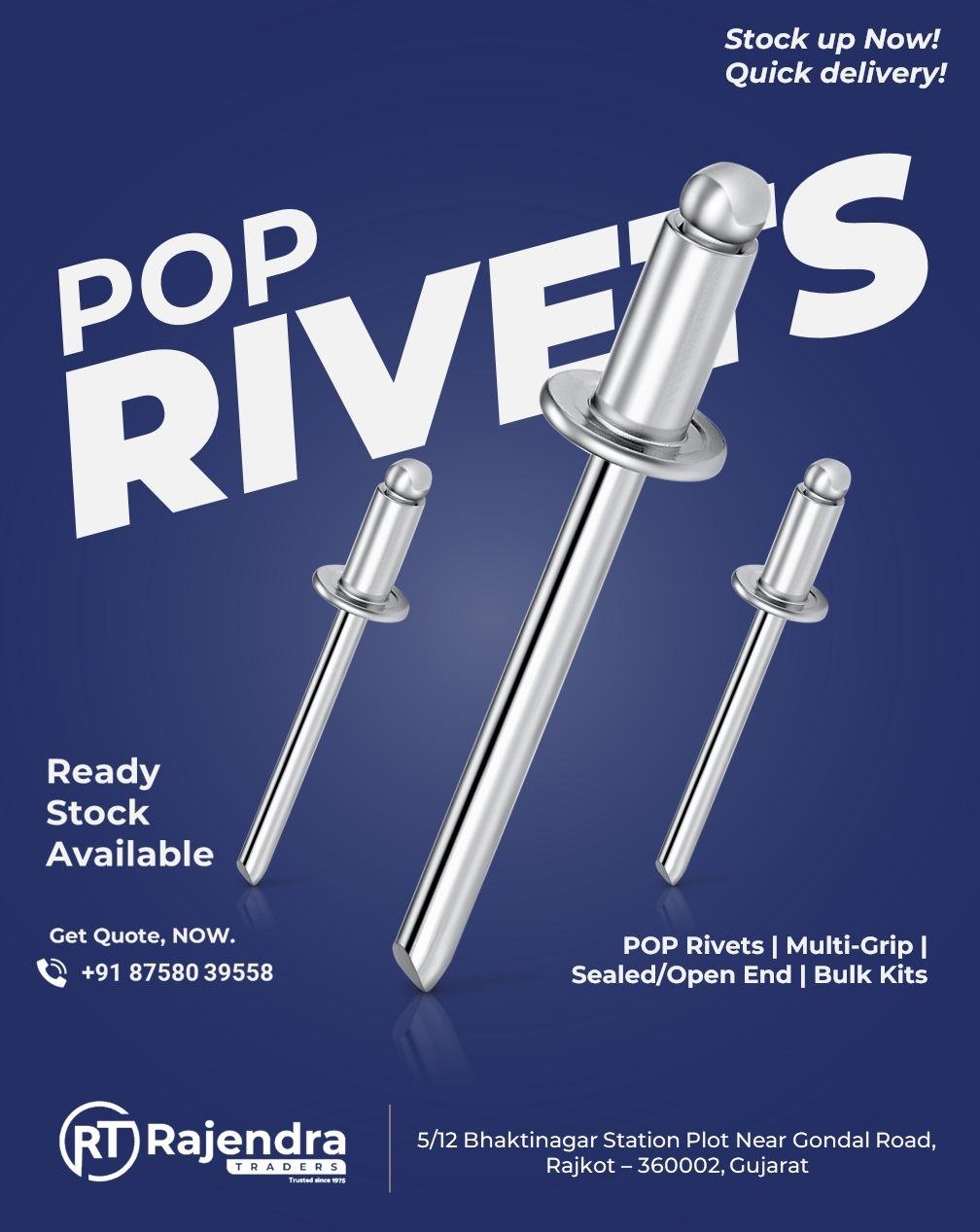
Product Specification :
A Pop Rivet, also known as a blind rivet, is a two-piece permanent fastener consisting of a hollow rivet body (shell) and a central mandrel (stem). They are designed for "blind" applications where only one side of the workpiece is accessible.
1. Anatomy and Operation
Rivet Body: The part that remains in the workpiece. It expands to create a permanent join.
Mandrel: The rod that is pulled through the body by a rivet tool. It features a "head" that deforms the body and then snaps off at a pre-determined break point.
2. Material Combinations
Pop rivets are often made from a combination of materials to balance strength, weight, and corrosion resistance. The first material listed is usually the body, and the second is the mandrel (e.g., Al/St).
Combination Properties Common Use
Aluminum / Aluminum Lightweight, highly corrosion-resistant, low strength. Signage, ductwork, jewelry.
Aluminum / Steel Good strength-to-weight ratio; steel mandrel provides more pull. Automotive trim, general DIY.
All Steel High shear and tensile strength. Structural steel, heavy machinery.
Stainless Steel Ultimate corrosion resistance and high strength. Marine, food processing, medical.
Copper / Steel High electrical conductivity. Electrical grounding and roofing.
3. Head Styles
Dome Head: The most common. Provides a wide bearing surface for general applications.
Countersunk (CSK): Sits flush with the material surface; requires a pre-countersunk hole.
Large Flange: Features a much wider head to prevent "pull-through" when fastening soft materials like plastic or wood to metal.
4. Technical Specifications
Diameter: Common sizes include 3/32" (2.4mm), 1/8" (3.2mm), 5/32" (4.0mm), and 3/16" (4.8mm).
Grip Range: Perhaps the most critical spec. It defines the total thickness of the materials being joined (e.g., a grip range of $3.2\text{--}4.8\text{mm}$).
Shear Strength: The force required to snap the rivet sideways.
Tensile Strength: The force required to pull the rivet out straight.
5. Specialized Types
Closed-End (Sealed): The body is completely enclosed at the tip. Used to create water-tight or pressure-tight seals.
Multi-Grip: Designed to work across a wider range of material thicknesses, reducing the number of different sizes a technician needs to stock.
Peel (Tri-Fold): The body splits into three "legs" upon expansion. Ideal for brittle or soft materials.
6. Installation Best Practices
Hole Sizing: The drill hole should be approximately $0.1\text{mm}$ larger than the rivet diameter. A loose hole will result in a weak, spinning rivet.
Perpendicularity: Always hold the rivet gun at $90^\circ$ to the workpiece to ensure the head sits flat.
Removal: To remove a pop rivet, simply use a drill bit the same size as the rivet diameter and drill through the center of the head.
Contact our export experts for detailed specifications, pricing, and shipping information.
Contact rajendra traders